


Enhancing Panel Drawing Dimensioning in BIM Software using Recommender Systems
Vertex Systems have always offered Master´s Thesis opportunities to university students to support their academic and professional qualifications. There are more than 40 Master´s Theses completed for Vertex during the years. The research results are implemented in our product development to provide cutting-edge software solutions for our customers.
In the “My Master´s Thesis Journey” blog series, our young professionals tell about their Master´s theses and what they have learned and accomplished during the journey.”
Maaliskuu 2026
Johannes Simulainen
Ohjelmistosuunnittelija

Background
I started my journey at Vertex as a summer trainee in 2022, eventually moving into a part-time role alongside my studies. Throughout this time, I’ve been working on Vertex BD development, starting with IFC (Industry Foundation Classes) features before diving into the core areas of the software.
One area that stood out to me was the creation of panel drawing templates. Panel drawings are critical for translating design intent into manufacturing instructions. However, setting up the templates that generate these drawings is time-consuming. Users are often presented with a list of over 100 different dimension types to choose from. Finding the appropriate ones in this long list contributes to choice overload and slows down the design process.
With the guidance of my supervisors, we identified this as a perfect candidate for my Master of Science thesis. The goal was to investigate if we could automate and ease this decision-making process using machine learning.
Bringing Recommender Logic to BIM
To solve this, I looked for inspiration outside the construction industry. We interact with Recommender Systems daily on platforms like YouTube or Spotify. These systems analyze your viewing history or the genre of a song to filter millions of options down to a handful of relevant suggestions.
I wanted to bring this same logic to Vertex BD. Rather than scrolling through a static list of over 100 options, the software should analyze the current drawing and give only a few dimensions relevant to the user’s immediate task.
However, recommending dimensions presents a different challenge. Unlike music platforms that benefit from rich structured metadata, panel drawing dimensions have messy and inconsistent parameter strings. If we relied on hard-coded manual rules, the system would be fragile and difficult to maintain.
To overcome this, I focused on generalizability by utilizing BERT. BERT relies on technology similar to the modern AI chatbots, allowing the system to “understand” the function of a dimension based on its data. This gives the system an ability to identify without manual classification that, for example, truss dimensions are similar to each other.
A Hybrid Recommendation Approach
Understanding the data alone was not enough, as the system also needed to adapt to the user. Out of the three distinct recommendation algorithms, no single algorithm worked perfectly for every scenario. So, I experimented with combining these algorithms. The best performing model combined two strategies:
1. The Collaborative Strategy: When the user has already added dimensions to the template, the system can compare the template being built to a collection of previously made templates to generate suggestions. The system analyzes historical data to see what other users did in similar situations, effectively saying “Users who built truss templates like this usually added these specific dimensions.”
2. The Content-Based Strategy: When a user creates a new template, the system has no dimensions to rely on for comparison. In this scenario, it combines the user’s history with a Content-Based approach that looks at the dimensions already in the view and suggests others that are functionally similar. The intuition behind the system is that the user might want to add a dimension for “opening height” after they have added a dimension for “opening width”.
The hybrid model combines these strengths, providing more useful suggestions at the start of the template creation process, while the more powerful collaborative strategy gains more emphasis as the template is being built.
Validating the Solution
Since we couldn’t test and optimize the recommender system on live users, I built a program that simulates the template creation process. I took a dataset of 622 real-world templates and stripped away 50-100% of their dimensions. The templates were then iteratively rebuilt, while the recommender generated suggestions in each iteration. These recommendations were then examined to see how well the recommender was able to find the missing dimensions. Success was measured by how often the top recommendations contained dimensions that were previously removed from a simulated template. A diagram of the simulation process is depicted below.
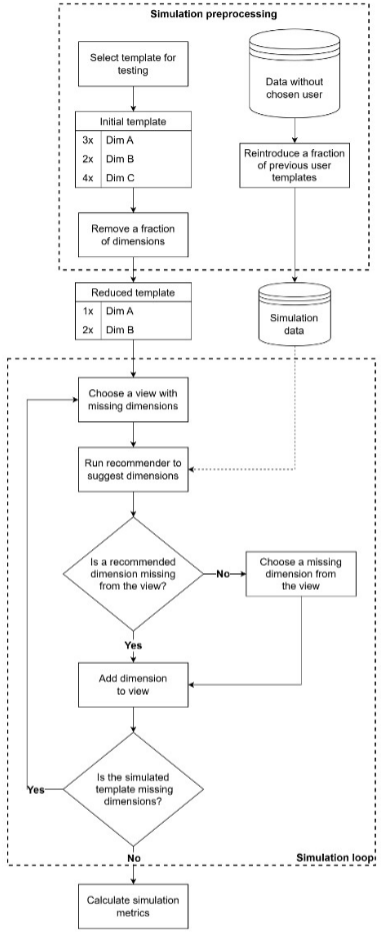
The results were promising. On average, the system could successfully recover 78 % of the missing dimensions within the top 5 suggestions, although there was variance between different templates.
Furthermore, the system was computationally efficient, generating recommendations in milliseconds. This confirmed that the system could be integrated into Vertex BD without introducing lag or slowing down the user’s workflow.
Conclusion
This thesis showed that recommender systems can meaningfully reduce choice overload in BIM workflows. The simulation framework and hybrid recommendation logic are not specific to dimensions, so the same approach could be applied to other selection tasks in Vertex BD, such as component libraries.
For me personally, this project was a close look at the intersection of AI and structured BIM data. It gave me a clearer understanding of the importance of data in building smarter tools, and I look forward to applying these insights to future development at Vertex.